
Facebook is one of the most widely used social media platforms for connecting with people, sharing content, and promoting businesses. However, publishing a post does not mean that every follower will see it.
How the Facebook Algorithm Works in 2026: A Complete Guide for Marketers and Creators
Facebook uses an advanced algorithm to decide which posts, videos, Reels, and recommendations appear on each person’s feed.
Understanding how the Facebook algorithm works in 2026 is important for business owners, digital marketers, social media managers, and content creators. It helps them create better content, reach the right audience, and improve engagement.
In this guide, you will learn how Facebook ranks content, how its Feed and Reels recommendations work, what has changed recently, and how you can improve your Facebook marketing strategy.
What Is the Facebook Algorithm?
The Facebook algorithm is a group of artificial intelligence and machine learning systems that decide which content people see on Facebook and in what order.
Every Facebook user has different interests and activities. Some people enjoy watching Reels, while others prefer business updates, news, photographs, or posts from friends.
Facebook studies these interests and activities to recommend content that may be useful or interesting to each person.
For example, if someone regularly watches cooking videos, Facebook may recommend more cooking-related Reels and posts.
If another person often interacts with digital marketing content, they may see more posts about SEO, advertising, and social media marketing.
This personalised process helps Facebook organise a large amount of content for each user.
How Does the Facebook Algorithm Work in 2026?
Facebook uses AI-powered ranking and recommendation systems to decide what appears in Feed, Reels, and other areas of the platform.
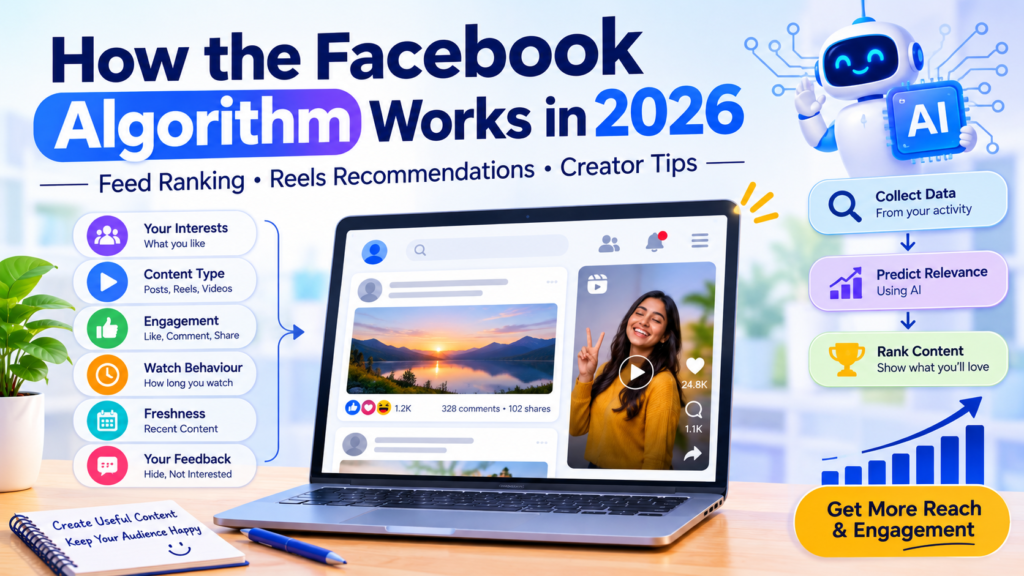
The system considers several factors, including:
- User interests and previous activity.
- Relationships with friends, Pages, and Groups.
- Content type.
- Likes, comments, and shares.
- Video viewing behaviour.
- Content freshness.
- User feedback.
- Content quality and originality.
Facebook does not use one simple formula for every part of the platform. Different areas, such as Feed and Reels, can use different recommendation systems.
The main goal is to show people content that is relevant to their interests and likely to provide value.
The Four Main Steps of Facebook Content Ranking
A useful way to understand Facebook Feed ranking is through four main steps: Inventory, Signals, Predictions, and Score.
1. Inventory
Inventory means the content that Facebook can consider showing to a user.
This may include:
- Posts from friends.
- Updates from followed Pages.
- Posts from Groups.
- Photos and videos.
- Reels.
- Recommended content from accounts the user does not follow.
Facebook first identifies available content that may be relevant to the person.
2. Signals
Signals are the information used to understand the user, the content, and the relationship between them.
Examples include:
- Who published the post.
- Whether the user has interacted with that account.
- The type of content.
- Previous likes, comments, and shares.
- How long someone watches a video.
- Whether people share or save the content.
- How recent the post is.
Facebook uses many signals. Their importance can vary depending on the type of content and the person viewing it.
3. Predictions
Facebook uses AI systems to predict how a person may respond to a particular post.
For example, the system may estimate whether someone is likely to:
- Watch a video.
- Comment on a post.
- Share content with friends.
- React to a photo.
- Visit a Page.
- Show interest in a recommended Reel.
These predictions help Facebook understand which content may be useful to that person.
4. Ranking Score
Facebook combines different predictions and signals to decide the order in which content appears.
Content predicted to be more relevant may receive a higher position in a person’s feed.
However, a high number of likes does not automatically guarantee a high ranking. Facebook considers several factors together.
Important Facebook Algorithm Ranking Factors in 2026
Understanding ranking factors can help you plan better social media content.
1. User Interests
Facebook learns from the content people view and interact with.
If your audience regularly engages with educational videos, business tips, or product demonstrations, content related to those interests may be more relevant to them.
2. Engagement
Engagement includes reactions, comments, shares, and other interactions.
Content that encourages genuine discussion and meaningful sharing can provide useful signals about audience interest.
Do not use misleading captions or artificial engagement methods. Focus on real conversations.
3. Content Type
Different people prefer different formats.
Some users enjoy Reels, while others prefer photographs, text updates, links, or longer videos.
Understand what your audience responds to and use a suitable mix of formats.
4. Watch Time
Watch time is especially important for video recommendations.
Facebook can use viewing behaviour to understand whether people are interested in a video.
Create videos with a clear opening, useful information, and a natural flow. Avoid unnecessary introductions that make viewers leave.
5. Content Freshness
Recent content can be useful when people want timely information.
Posting regularly helps you share updates with your audience, but publishing too frequently does not automatically improve reach.
Prioritise useful and relevant posts over unnecessary uploads.
6. Original Content
Original content is an important focus for Facebook.
Meta has stated that it is working to reward original creators with greater reach and monetisation opportunities while reducing the distribution of unoriginal content.
Content created by you or your business can offer more value than simply copying another creator’s work.
If you use third-party material, add meaningful commentary, analysis, information, or creative value rather than making only minor changes.
7. Relationship with the Audience
Facebook may consider how people interact with friends, Pages, and Groups.
When users regularly interact with a particular Page or person, content from those sources may become more relevant to them.
Building a genuine community can help your business maintain meaningful connections with followers.
How Does the Facebook Feed Algorithm Work?
The Facebook Feed is the main area where people see posts, photos, videos, updates, and recommendations.
It can include content from:
- Friends and family.
- Followed Pages.
- Joined Groups.
- Recommended creators.
- Suggested posts.
Facebook uses ranking systems to organise this content based on each person’s interests and activity.
For example, if a person regularly interacts with a local business Page, Facebook may consider future updates from that Page relevant to the person.
How Can You Improve Facebook Feed Visibility?
- Publish useful and original posts.
- Understand your audience’s interests.
- Use clear and relevant captions.
- Share information that encourages genuine discussion.
- Add suitable images and videos.
- Respond to comments.
- Avoid misleading engagement tactics.
- Review your Page performance regularly.
How Does the Facebook Reels Algorithm Work in 2026?
Facebook Reels is an important content discovery feature.
Unlike content that comes only from followed accounts, Reels can introduce users to creators and Pages they have never interacted with before.
Facebook uses recommendation systems to predict which videos people may enjoy.
Important Reels signals can include:
- Viewing behaviour.
- Watch time.
- Likes and comments.
- Shares.
- User interests.
- Content originality.
- Feedback from viewers.
- Video information and quality.
Meta also announced improvements to Facebook Reels recommendations in January 2026. These improvements use direct user feedback to help identify people’s interests, including interest in more specific and niche content.
This means that creators should focus on making videos that genuinely match the interests of their target audience.
Tips to Improve Facebook Reels Performance
- Start your video with an interesting opening.
- Focus on one clear topic per Reel.
- Use good lighting and clear audio.
- Add readable captions.
- Share original videos.
- Keep the video focused and useful.
- Use relevant descriptions.
- Encourage genuine sharing and discussion.
- Review watch time and audience retention.
- Learn from your best-performing videos.
Do not assume that a particular video length or posting frequency guarantees success. Test different formats and review your audience’s response.
Important Facebook Algorithm Updates in 2026
Meta has announced several changes and improvements that creators and marketers should understand.
1. More Focus on Original Content
In March 2026, Meta shared updated guidance about original content.
It explained that content created directly by a creator or Page owner is considered original. Reposting another creator’s content with only minor changes may be treated as unoriginal.
For example, adding a border, changing the video speed, or adding basic captions to someone else’s Reel does not necessarily make it original.
Creators should add their own ideas, information, creative work, or meaningful commentary.
2. Improved Reels Personalisation
In January 2026, Meta explained improvements to its Facebook Reels recommendation system.
The updated approach uses direct feedback about users’ interests, rather than depending only on signals such as likes and watch time.
This can help Facebook recommend more relevant and specific content.
3. More User Control Over Recommendations
In October 2026, Meta introduced new AI-powered tools called “Your Algorithm.”
These tools allow users to communicate their interests in their own words and influence the topics they see in Feed and Reels.
Users can access recommendation controls through the three-dot menu and provide feedback about content they want to see more or less of.
This makes personalisation more interactive and gives users additional control over their recommendations.
How to Customise Your Facebook Feed
Facebook provides several controls that allow users to influence the content they see.
1. Use Interested and Not Interested
When available, use the Interested or Not Interested feedback options to tell Facebook what type of content you prefer.
2. Manage Your Feed
Facebook provides feed controls that may include options to manage favourites, unfollow accounts, snooze people, and reconnect with accounts.
The exact options can vary by account and app version.
3. Use the Show More and Show Less Options
When available, use Show More or Show Less from a post’s menu to influence recommendations.
These choices help Facebook understand your content preferences.
4. Review Your Algorithm Settings
Meta’s October 2026 Your Algorithm feature provides additional ways to manage topics and recommendations.
Availability and rollout may vary between accounts and regions.
10 Tips to Improve Your Facebook Reach in 2026
If you manage a Facebook Page or business account, follow these practical tips.
1. Create Original Content
Publish your own photographs, videos, graphics, educational posts, and business updates.
Original content helps your brand develop a recognisable identity.
2. Understand Your Target Audience
Before publishing, understand your audience’s age group, interests, location, needs, and common questions.
Create content that solves their problems or provides useful information.
3. Use Different Content Formats
Do not depend on only one type of post.
Experiment with:
- Reels.
- Educational graphics.
- Photographs.
- Text updates.
- Stories.
- Live videos.
- Customer experiences.
Measure the performance of each format.
4. Write Clear Captions
Use simple language and explain the main point of your post.
Your caption should tell people why the content is useful or interesting.
5. Publish at Suitable Times
The best posting time depends on when your audience is active.
Check your Page insights to understand when your followers are online.
Do not depend on a universal posting-time chart because every audience behaves differently.
6. Encourage Genuine Conversations
Ask relevant questions, share useful information, and respond to comments.
Avoid asking people to leave meaningless comments just to increase engagement.
7. Use Relevant Topics and Keywords
Use natural keywords in your captions and descriptions so people can understand what your content is about.
For example, a Pune-based digital marketing business may naturally mention topics such as social media marketing, SEO, website development, or digital marketing services in Pune.
Avoid adding unrelated hashtags or repeating keywords unnecessarily.
8. Create Useful Reels
Make videos that teach, explain, demonstrate, entertain, or solve a problem.
The first few seconds should make the topic clear and give viewers a reason to continue watching.
9. Maintain a Consistent Content Plan
Create a realistic publishing schedule.
For example, you may plan educational posts, Reels, business updates, and customer stories across the week.
Consistency helps your team manage content, but quality should remain the priority.
10. Review Your Performance
Use Facebook Page insights and professional dashboard tools to review your content.
Identify which posts receive useful engagement, reach, shares, and video views.
Use these findings to improve your next content plan.
How to Measure Facebook Algorithm Performance
You cannot directly see Facebook’s complete ranking formula, but you can measure how your content performs.
Important metrics include:
| Metric | What It Helps You Understand |
|---|---|
| Reach | How many people saw your content |
| Impressions | How often your content was displayed |
| Engagement | How people interacted with your posts |
| Shares | How often people shared your content |
| Comments | How much discussion your content created |
| Video views | How often your videos were viewed |
| Watch time | How long people watched your videos |
| Follower growth | How your Page audience is changing |
| Link clicks | How many people visited your website through a link |
Review these metrics over time rather than judging your entire strategy from one post.
Common Facebook Algorithm Mistakes to Avoid
Some publishing practices can reduce content quality and damage audience trust.
Avoid these mistakes:
- Copying content from other creators.
- Posting low-quality videos.
- Using misleading headlines.
- Sharing unrelated hashtags.
- Buying fake likes and followers.
- Using spam comments.
- Publishing content without understanding your audience.
- Repeatedly sharing the same post.
- Ignoring comments and messages.
- Focusing only on likes instead of useful results.
A strong Facebook strategy should focus on audience value, original content, and long-term trust.
Conclusion
The Facebook algorithm in 2026 uses AI-powered systems to understand user interests and recommend relevant content across Feed and Reels.
It considers different signals, including engagement, viewing behaviour, content type, freshness, originality, and user feedback.
For marketers and creators, the best approach is to understand the audience, publish original content, create useful Reels, encourage genuine interaction, and review performance regularly.
Facebook’s recommendation systems continue to change. Staying updated with Meta’s official announcements and adapting your content strategy can help your business build a stronger presence on the platform.
Frequently Asked Questions (FAQs)
1. How does the Facebook algorithm work in 2026?
Facebook uses AI-powered ranking systems to understand user interests and organise posts, Reels, and recommendations. It considers signals such as user activity, content type, engagement, viewing behaviour, and feedback.
2. What are the four steps of Facebook ranking?
The four commonly used steps are Inventory, Signals, Predictions, and Score. These explain how available content is identified, evaluated, and ranked.
3. Does Facebook favour Reels in 2026?
Reels are an important part of Facebook’s content discovery experience. However, performance depends on relevance, viewer interests, content quality, and other ranking signals.
4. Does Facebook reduce the reach of copied content?
Meta has stated that it is reducing the distribution of unoriginal content and prioritising original creators. Minor changes to another person’s content may not make it original.
5. How often should I post on Facebook?
There is no universal posting frequency that guarantees better reach. Choose a realistic schedule and focus on publishing useful content consistently.
6. What is the best time to post on Facebook?
The best time depends on your audience. Review your Page insights to understand when your followers are active.
7. Do hashtags help Facebook reach?
Relevant hashtags may help describe a topic, but they do not guarantee higher reach. Use them naturally and avoid unnecessary hashtags.
8. Can I increase Facebook reach without paid advertising?
Yes. You can work on organic reach by publishing original content, understanding your audience, creating useful Reels, and encouraging genuine engagement. Organic reach is not guaranteed.
9. Does Facebook use AI to recommend content?
Yes. Meta uses AI and machine learning systems to rank and recommend content based on user interests, activity, and other signals.
10. What is the biggest Facebook algorithm change in 2026?
Important developments include stronger efforts to reward original content, improvements to Reels personalisation, and the October 2026 introduction of AI-powered Your Algorithm controls.




Comments
Share your thoughts