
When you create a website, two important things you need to understand are domain names and web hosting. Many beginners think that both are the same, but they have different purposes.
Difference Between Domain and Hosting: A Complete Guide with Examples
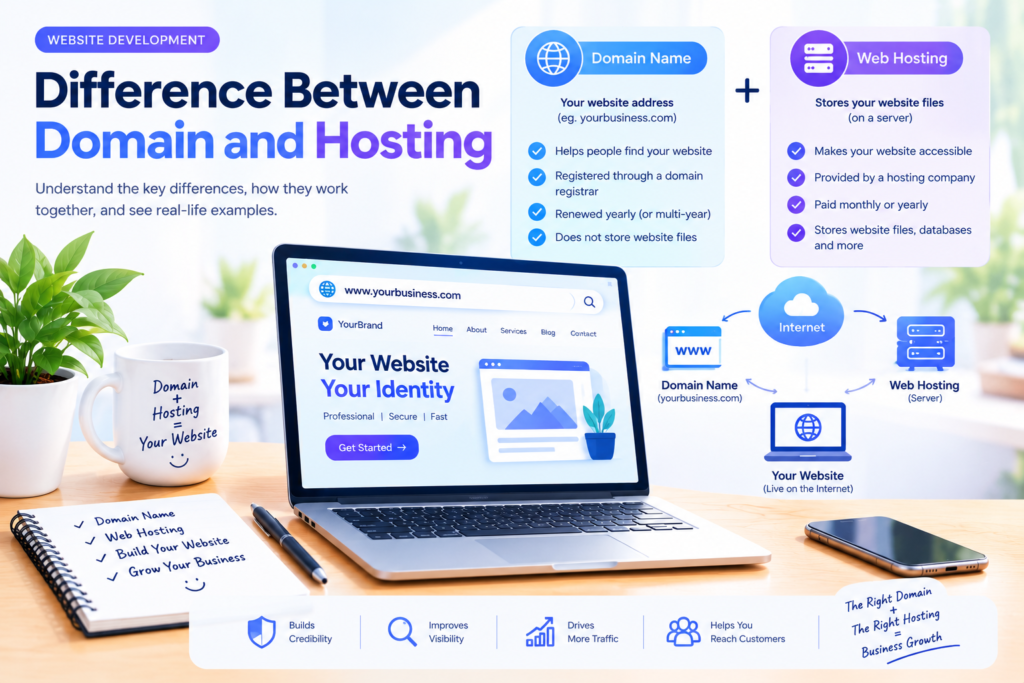
A domain name is the address people use to visit your website. Web hosting is the service that stores your website files and makes them available on the internet.
For example, if you want to create a business website, you may register a domain such as yourbusiness.com and purchase a web hosting plan to store your website files. Both services work together to make your website accessible to visitors.
But what is the actual difference between domain and hosting? Can you buy a domain name without hosting? Do you need both services? How much does hosting cost?
In this guide, we will explain the difference between domain and hosting with simple examples. We will also discuss domain registration, hosting prices, free hosting options, and how to choose the right services for your website.
1. What Is a Domain Name?
A domain name is the unique address that people use to find and visit your website on the internet.
For example:
- google.com
- amazon.in
- microsoft.com
- wikipedia.org
- yourbusiness.com
Every website needs an address that visitors can use to access it. A domain name makes this process simple.
Computers communicate using IP addresses. These addresses contain numbers that are difficult for most people to remember. A domain name provides an easy alternative.
For example, instead of remembering a long numerical IP address, you can simply type google.com into your browser.
A domain name is also an important part of your online brand identity. Businesses often use their company name as their domain name to make their website easier to recognise.
2. What Is Web Hosting?
Web hosting is a service that stores your website files on a server and makes them accessible through the internet.
A website contains different files, including:
- Website pages.
- Images and videos.
- HTML, CSS, and JavaScript files.
- WordPress themes and plugins.
- Databases.
- Documents and other resources.
These files need to be stored on a server so visitors can access your website.
A web hosting provider offers server space, storage, and other resources to keep your website available online.
For example, if you create a WordPress website for your business, you need a hosting service to store your WordPress installation, images, pages, and database.
When someone visits your domain name, the hosting server delivers the required website content to their browser.
In simple words, hosting is the online space where your website lives.
3. What Is the Difference Between Domain and Hosting?
The main difference between domain and hosting is their purpose.
A domain name is your website’s address, while hosting is the service that stores your website files.
Think about a physical shop.
Your shop has a name and an address. It also needs a building where you can keep your products and serve customers.
A website works in a similar way.
- Domain name: Your online address.
- Web hosting: The space where your website files are stored.
- Website: The actual pages, images, and content visitors see.
You need to connect your domain with your hosting server so people can access your website through your domain name.
Domain vs Hosting: Comparison Table
| Feature | Domain Name | Web Hosting |
|---|---|---|
| Main purpose | Provides a website address | Stores website files |
| Example | yourbusiness.com | Server space |
| Main function | Helps people find your website | Delivers website content |
| Purchased from | Domain registrar | Hosting provider |
| Payment | Registration and renewal | Hosting subscription |
| Renewal | Usually yearly | Monthly or yearly, depending on the plan |
| Storage | Does not store website files | Stores website files |
| Required for a custom website address | Yes | Hosting is needed for a self-hosted website |
| Can be purchased separately | Yes | Yes |
Both services are different, but they work together to make your website available online.
4. Difference Between Domain and Hosting with Example
Let’s understand the difference with a real-life example.
Imagine that you own a company called ABC Digital Solutions and want to create a business website.
You choose a domain name:
Next, you purchase a web hosting plan from a hosting provider.
You install WordPress and upload your website content to the hosting server.
Now your website is ready to be accessed through abcdigital.in.
Here is how everything works:
Domain: abcdigital.in
This is the address customers enter into their browsers.
Hosting: Your selected hosting server.
This is where your website files, images, database, and other content are stored.
Website: Your actual business website.
This includes your homepage, about page, services, portfolio, blog, and contact page.
When a visitor enters abcdigital.in, DNS connects the domain to the correct hosting server. The server then delivers your website to the visitor’s browser.
This is a simple example of how domain and hosting work together.
5. What Is the Difference Between Domain Name and Web Hosting?
A domain name and web hosting are two separate services.
You can register a domain name without purchasing hosting. You can also purchase hosting without registering a new domain if you already own a domain or use a temporary address provided by the hosting platform.
For example, you may purchase a domain from one company and hosting from another company.
Suppose:
- Domain provider: Company A.
- Hosting provider: Company B.
- Website platform: WordPress.
You can connect your domain from Company A to your hosting account with Company B by configuring the correct DNS settings.
You do not have to purchase both services from the same company.
This gives you more flexibility when selecting domain and hosting providers.
6. Can I Buy a Domain Name Without Hosting?
Yes. You can buy a domain name without purchasing a web hosting plan.
Domain registration and web hosting are separate services.
For example, you may register yourbusiness.com today and decide to build your website after a few months.
During this period, you can keep the domain registered in your name and connect it to a hosting service later.
You can also use a registered domain for:
- Professional email addresses.
- Domain forwarding.
- Brand protection.
- Future website development.
- Temporary landing pages, if supported by your provider.
However, simply purchasing a domain does not create a complete website.
If you want visitors to see your website pages, you need to connect the domain to a hosting platform or another suitable website service.
7. Do I Need Hosting for My Domain?
You do not need hosting just to register and keep a domain name.
However, you need some form of hosting or website platform if you want to publish a website that visitors can access.
For example, you can purchase a domain name and keep it unused for future projects.
You can also connect it to a professional email service without hosting a traditional website.
If you want to create a self-hosted WordPress website, you need a compatible hosting environment.
The requirement depends on how you plan to use your domain.
8. What Is the Difference Between Domain and Subdomain?
A domain name is the main address of your website. A subdomain is an additional section created under your main domain.
For example:
- Main domain: example.com
- Subdomain: blog.example.com
- Subdomain: shop.example.com
- Subdomain: support.example.com
A subdomain helps you organise different sections of your website.
For example, you can use:
blog.yourbusiness.com for your blog.
shop.yourbusiness.com for your online store.
support.yourbusiness.com for customer support.
A subdomain is not the same as a separate registered domain. It is created under an existing domain and configured through DNS and hosting settings.
9. What Are the 7 Types of Domains?
There are different domain categories and extensions. Here are seven useful types to understand.
1. Generic Top-Level Domains (gTLDs)
These are common domain extensions used for different purposes.
Examples:
- .com
- .org
- .net
- .info
- .biz
2. Country Code Top-Level Domains (ccTLDs)
These extensions are connected to specific countries.
Examples:
- .in – India
- .uk – United Kingdom
- .us – United States
- .au – Australia
3. Sponsored Top-Level Domains (sTLDs)
These extensions are intended for specific communities or organisations.
Examples include .edu and .gov, which have eligibility requirements.
4. New Generic Top-Level Domains
These provide additional domain name options.
Examples:
- .online
- .store
- .tech
- .website
- .design
5. Second-Level Domains
In example.com, the word example is the second-level domain label.
It is generally the main name selected when registering a domain.
6. Third-Level Domains
In blog.example.com, the word blog is a third-level label and functions as a subdomain.
7. Internationalised Domain Names
These domain names support characters from different languages and writing systems.
They are useful for websites that want to use local languages in their domain names.
10. How Much Does Domain and Hosting Cost?
The price of a domain and hosting depends on the provider, domain extension, hosting type, and features you select.
A domain name generally requires a registration fee and periodic renewal.
Web hosting usually requires a monthly or yearly subscription.
Some providers offer introductory discounts for new customers. However, the renewal price may be different.
When checking domain and hosting prices in India, consider the following:
Domain registration cost:
- Domain extension.
- First-year registration price.
- Renewal charges.
- Domain privacy options.
- Applicable taxes.
Hosting cost:
- Hosting type.
- Storage capacity.
- Server resources.
- Bandwidth or traffic limits.
- Backup features.
- Security options.
- Support services.
- Renewal charges.
How Much Is One Year of Hosting?
There is no fixed price for one year of hosting.
A basic shared hosting plan usually costs less than managed WordPress, VPS, cloud, or dedicated hosting.
For a small business website, shared hosting or managed WordPress hosting may be a suitable starting point.
For a larger website, you may need more resources and a higher hosting budget.
Always compare the complete yearly cost instead of selecting a plan based only on its introductory price.
11. Can I Get a Domain Name for 1 Rupee?
Some domain providers may advertise very low promotional prices, including offers close to ₹1, for selected customers, extensions, or limited periods.
However, these offers may include conditions.
Before purchasing, check:
- Whether the offer applies to the domain extension you want.
- Whether it is limited to the first year.
- The renewal price.
- Whether hosting or other products must be purchased.
- Applicable taxes and additional charges.
- Whether the offer is available to your account.
A ₹1 promotional price does not mean that you can maintain the domain permanently for ₹1.
Always review the complete pricing details before making a purchase.
12. What Is the Cheapest Way to Host a Website?
The cheapest way to host a website depends on your website type and technical requirements.
Here are some options.
Free Website Hosting
Some platforms offer free hosting for basic websites or learning projects.
However, free plans may have storage, traffic, feature, or custom-domain limitations.
Shared Hosting
Shared hosting is often an affordable option for small business websites and WordPress blogs.
Multiple websites use resources from the same physical server.
Static Website Hosting
If your website contains only static pages, some platforms offer free or low-cost hosting for suitable projects.
This can be a useful option for simple websites that do not require a traditional server-side application.
Introductory Hosting Offers
Some hosting providers offer discounts for new customers.
Compare renewal prices and included features before selecting an offer.
For a professional business website, the cheapest option is not always the best option. Reliability, security, backups, and support are also important.
13. Can I Host a Domain for Free?
Some platforms provide free hosting or free website publishing options.
However, a free domain and free hosting are not always included together.
You may receive a free subdomain such as:
yourname.platform.com
If you want to use your own custom domain, you may need to register it separately and connect it to the free hosting platform.
Free hosting may be suitable for:
- Personal learning projects.
- Small test websites.
- Static websites.
- Development experiments.
- Temporary projects.
For a professional business website, paid hosting may provide better control, support, and resources.
14. Can I Host a Domain Myself?
Yes, you can host a website on your own server or computer.
This is called self-hosting.
However, you need to manage several technical requirements, including:
- Server hardware or cloud infrastructure.
- Operating system.
- Web server software.
- Network connectivity.
- DNS configuration.
- SSL/TLS security.
- Firewall and server protection.
- Website backups.
- Software updates.
- Server monitoring.
If you host a website from your own computer, it may require a stable internet connection, suitable network configuration, and a public IP address.
For most beginners and small businesses, a professional hosting provider is easier to manage.
15. Can We Run a Website Without Hosting?
A website needs a hosting environment or server to be accessible to the public.
However, you do not always need to purchase a separate traditional hosting plan.
For example, website builders may include hosting in their subscriptions. Some static website platforms also provide free hosting.
You can also create and test a website locally on your computer without publishing it online.
The important difference is between creating a website and making it publicly accessible.
A website stored only on your computer is not normally available to other people through the internet.
16. Can I Own a Domain Name Permanently?
No. Standard domain registrations are generally not permanent.
You register a domain for a selected period and renew it before it expires.
If you do not renew it, the domain may eventually become available for registration by someone else, depending on the applicable expiry and recovery process.
Some registrars offer multi-year registration options.
To protect your domain:
- Enable automatic renewal if suitable.
- Keep your payment information updated.
- Use a valid contact email address.
- Enable account security.
- Monitor domain expiry notifications.
- Keep access to your registrar account secure.
Remember that registering a domain does not give you permanent ownership. It gives you registration rights for the applicable period under the registrar’s and registry’s terms.
17. What Are the Top 10 Domain Names?
If you are searching for popular domain extensions, here are ten widely recognised options.
- .com – Commonly used by businesses and brands.
- .in – Country-code domain for India.
- .org – Commonly used by organisations.
- .net – Traditionally associated with network-related services.
- .co – Used by many businesses and brands.
- .info – Suitable for information-based websites.
- .biz – Intended for business-related websites.
- .online – Suitable for online businesses.
- .tech – Often used by technology brands.
- .store – Suitable for online shopping websites.
This is a selection of recognised extensions, not an official ranking by registration volume.
The right extension depends on your brand, audience, and business requirements.
18. How to Choose the Right Domain and Hosting for Your Business?
Choosing the right domain and hosting services is an important step when building a professional website.
Here are some practical tips.
Choose a Simple Domain Name
Select a domain that is easy to read, remember, and type.
Whenever possible, use your business or brand name.
Select the Right Extension
For businesses targeting Indian customers, .in or .co.in may be suitable.
For businesses targeting an international audience, .com may be a good option.
Choose Reliable Hosting
Check server performance, uptime commitments, customer support, and available resources.
Check Security Features
Look for SSL/TLS support, backups, security monitoring, and account protection.
Compare Renewal Prices
Do not select a provider only because its first-year price is low.
Check the cost of renewing your domain and hosting.
Check WordPress Compatibility
If you are building a WordPress website, check whether the hosting plan supports WordPress, suitable PHP versions, databases, and the resources your website needs.
Plan for Future Growth
Choose a provider that allows you to upgrade your hosting plan when your website receives more visitors.
19. Domain and Hosting for Businesses in India, Maharashtra and Pune
If you are planning to create a business website in India, choosing the right domain and hosting provider can help establish a professional online presence.
Businesses in Pune and other parts of Maharashtra can select domain and hosting services based on their audience, website requirements, and budget.
For example, a Pune-based business may register a .in or .com domain and choose a hosting provider with suitable server infrastructure for its target customers.
When comparing website hosting in Pune or domain registration services in Maharashtra, remember that the provider does not always need to have a physical office in your city.
Focus on service quality, server performance, support availability, pricing, and security.
If your business serves customers across India, choose infrastructure that can support your wider audience.
A well-planned website with a suitable domain, reliable hosting, and useful content can support your SEO and digital marketing activities.
Conclusion
Domain and hosting are two important parts of creating a website, but they serve different purposes.
A domain name provides the address people use to visit your website. Web hosting stores your website files and makes them accessible online.
You can purchase these services from different companies or choose a provider that offers both.
Before selecting a domain and hosting plan, compare registration costs, renewal prices, hosting resources, security features, support, and future upgrade options.
Whether you are creating a personal portfolio, business website, WordPress blog, or online store, choosing the right domain and hosting services will give your website a strong starting point.
Remember, a professional website needs more than just a domain and hosting. It also needs good design, useful content, SEO, security, and regular maintenance.
Planning to build your own website? Explore my portfolio to learn more about website development, WordPress, SEO, and digital marketing. Get in touch to discuss your website requirements.
Frequently Asked Questions
1. What is the difference between domain and hosting?
A domain is the address people use to visit your website. Hosting is the service that stores your website files and delivers them to visitors.
2. Can I buy a domain name without hosting?
Yes. You can register a domain without purchasing a hosting plan. You can connect it to hosting whenever you are ready to publish your website.
3. What is a domain and hosting example?
For example, yourbusiness.com is your domain name, while the server space provided by your hosting company is your web hosting.
4. Do I need hosting for my domain?
You do not need hosting just to register a domain. However, you need a hosting platform or server to publish a website using that domain.
5. Can I get a domain name for 1 rupee?
Some providers may offer promotional prices close to ₹1 under specific conditions. Check the renewal price and other charges before purchasing.
6. How much is one year of hosting?
The cost depends on the provider, hosting type, resources, and plan. Shared hosting is generally more affordable than VPS or dedicated hosting.
7. Can I host a domain for free?
Some platforms offer free website hosting, but a custom domain usually requires separate registration. Free hosting may have limitations.
8. What is the cheapest way to host a website?
Free static hosting or basic shared hosting may be suitable for simple websites. For business websites, compare reliability, security, and support before selecting the cheapest plan.
9. Can I host a domain myself?
Yes. You can host your website on your own server, but you need technical knowledge to manage the server, network, security, DNS, and backups.
10. Can we run a website without hosting?
A public website needs a server or hosting platform. However, some website builders and publishing platforms include hosting in their services.
11. What is the difference between domain and subdomain?
A domain is the main website address, such as example.com. A subdomain is an additional address under it, such as blog.example.com.
12. Can I own a domain name permanently?
Standard domain registrations are not permanent. You can maintain your registration by renewing it according to the registrar and registry terms.





Comments
Share your thoughts