
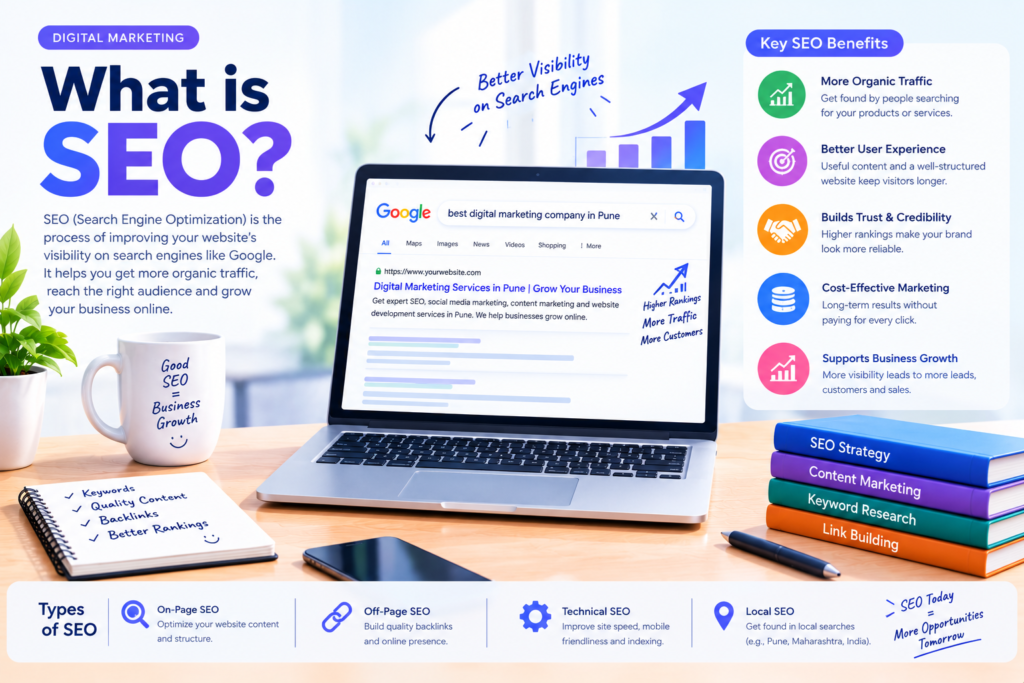
SEO stands for Search Engine Optimization. It is the process of improving a website so that it can appear more often in search engine results, such as Google and Bing.
What Is SEO? A Complete Beginner’s Guide to Search Engine Optimization
SEO stands for Search Engine Optimization. It is the process of improving a website so that it can appear more often in search engine results, such as Google and Bing.
When people search online for a product, service, or answer, they usually visit websites that appear in the search results. SEO helps your website become easier to find by improving its content, structure, technical performance, and online reputation.
For example, if someone searches for “best digital marketing services in Pune,” a business with good SEO may appear in the search results. This can help the business attract visitors, generate enquiries, and reach more customers without paying for every website visit.
In this guide, you will learn what SEO is, how it works, how to do SEO for beginners, its four main types, SEO tools, career opportunities, salary expectations in India, and how AI is changing SEO.
What Is SEO in Digital Marketing?
SEO in digital marketing is a strategy used to increase the number of visitors who reach a website through unpaid search engine results.
Digital marketing includes many activities, such as social media marketing, email marketing, paid advertising, content marketing, and SEO. SEO focuses on improving a website’s visibility in organic search results.
For example, imagine you own a clothing store in Pune. You create a website and publish pages about your products. When someone searches for “women’s clothing store in Pune,” you want your website to appear in relevant results.
SEO helps you work towards that goal.
SEO marketing can support a business in several ways:
- Improve website visibility.
- Attract relevant visitors.
- Build trust with potential customers.
- Generate enquiries and sales.
- Improve the overall website experience.
- Support long-term digital marketing growth.
What Is SEO and How Does It Work?
Search engines use automated systems to discover, understand, and organise website pages. When someone searches for something, the search engine tries to show useful and relevant results.
SEO works by helping search engines understand your website and helping visitors find the information they need.
The process generally includes three stages:
1. Crawling
Search engines use automated programs, often called crawlers or bots, to discover website pages and follow links.
2. Indexing
Search engines analyse the information they find. They may store eligible pages in their search index so that those pages can appear in search results.
3. Ranking
When someone enters a search query, search engines use many signals to decide which results are most relevant and useful.
Good SEO helps improve your website’s chances of appearing for relevant searches. However, no SEO professional can guarantee the first position on Google.
What Is SEO for a Website?
Website SEO means improving different parts of a website so that search engines and visitors can understand it easily.
For example, a website selling mobile phones can create separate pages for different phone models. Each page should have useful information, clear headings, relevant images, descriptive URLs, and helpful product details.
Important website SEO activities include:
- Writing useful and original content.
- Using relevant keywords naturally.
- Creating clear page titles and meta descriptions.
- Improving website loading speed.
- Making the website mobile-friendly.
- Adding internal links between related pages.
- Improving website navigation.
- Fixing broken links and technical errors.
- Adding suitable image alt text.
- Creating a sitemap and checking indexing.
SEO is not only about adding keywords. It is about creating a website that gives visitors a useful experience.
What Are the Four Types of SEO?
There are four commonly discussed types of SEO: On-Page SEO, Off-Page SEO, Technical SEO, and Local SEO.
1. On-Page SEO
On-Page SEO means improving the content and elements available directly on your website.
Examples include:
- Keyword research.
- SEO-friendly headings.
- Page titles and meta descriptions.
- Useful blog articles.
- Image optimisation.
- Internal linking.
- Clear website content.
For example, if you write an article about website development, you can use relevant phrases such as “website development services” and “professional website design” where they naturally fit.
2. Off-Page SEO
Off-Page SEO includes activities outside your website that can help build its reputation and authority.
Examples include:
- Earning quality backlinks.
- Digital PR.
- Business and industry mentions.
- Relevant guest contributions.
- Building genuine brand awareness.
- Getting authentic customer reviews where appropriate.
The focus should be on earning relevant and trustworthy references, not buying large numbers of low-quality links.
3. Technical SEO
Technical SEO focuses on making your website easier for search engines to crawl, understand, and index.
Important activities include:
- Improving website speed.
- Fixing crawl errors.
- Creating XML sitemaps.
- Using HTTPS security.
- Checking mobile usability.
- Managing duplicate URLs.
- Improving website structure.
- Checking indexing problems.
- Reviewing Core Web Vitals.
Technical SEO is important because even useful content can struggle to perform if search engines cannot properly access or understand the page.
4. Local SEO
Local SEO helps businesses appear in searches connected to a particular location.
For example, a person may search for:
- Digital marketing agency in Pune.
- Website developer in Pimpri-Chinchwad.
- Graphic designer near me.
- SEO services in Maharashtra.
Local SEO activities include maintaining an accurate Google Business Profile, using relevant location information, collecting genuine reviews, and creating useful local website pages.
Local SEO is especially useful for shops, restaurants, service providers, clinics, agencies, and other businesses that serve customers in specific areas.
How to Do SEO for Beginners?
You do not need to be an expert to start learning SEO. You can begin with a small website or blog and improve it step by step.
Follow this beginner-friendly SEO process.
Step 1: Understand Your Audience
First, identify the people you want to reach.
Think about:
- What are they searching for?
- What problems do they want to solve?
- Which products or services interest them?
- What information would help them?
Understanding your audience helps you create useful content.
Step 2: Do Keyword Research
Keyword research means finding the words and phrases people use when searching online.
For example, if you provide website development services, relevant keywords may include:
- Website development services.
- WordPress website development.
- Website developer in Pune.
- Business website design.
- Affordable website development.
Choose keywords that match the topic and purpose of each page. Avoid using the same keyword everywhere.
Step 3: Create Useful Content
Write content that answers real questions. Use simple language, clear headings, examples, and helpful information.
Do not copy articles from other websites. Add your own knowledge, experience, examples, and useful explanations.
Step 4: Optimise Your Website Pages
Add descriptive page titles, meta descriptions, headings, image alt text, and clear URLs.
Use your main keyword naturally. Make sure the page is easy to read on both mobile phones and computers.
Step 5: Improve Technical SEO
Check your website speed, mobile layout, HTTPS security, broken links, and indexing status.
You can use Google Search Console to understand how Google discovers and displays your website.
Step 6: Build Your Website’s Reputation
Publish useful content consistently and work towards earning relevant links and genuine brand mentions.
Avoid spammy link-building methods.
Step 7: Track Your Results
SEO takes time. Monitor your website’s impressions, clicks, search queries, indexing, and organic traffic.
Review your results and improve pages that are not performing well.
Is SEO Paid or Free?
SEO can be started without paying for advertisements. Organic search traffic does not require you to pay Google for every click.
However, SEO work may involve costs.
For example:
- Hiring an SEO professional or agency.
- Purchasing paid SEO tools.
- Paying for website hosting and domain registration.
- Hiring content writers or designers.
- Investing in website development.
You can also use free tools such as Google Search Console, Google Analytics, and Google Trends.
The main difference is that SEO focuses on organic visibility, while paid search advertising allows businesses to pay for advertising placements.
Can You Do SEO by Yourself?
Yes. You can learn and manage basic SEO by yourself.
If you have a WordPress website, you can start by writing useful articles, researching keywords, improving page titles, adding internal links, and checking your website through Google Search Console.
However, larger websites may require more advanced skills in technical SEO, content strategy, analytics, and website development.
Start small, practise regularly, and learn from your results.
Is SEO Difficult to Learn?
SEO is not impossible to learn, but it requires regular practice.
The basic concepts are easy to understand. You can learn keyword research, page optimisation, content writing, and basic reporting as a beginner.
Advanced areas such as technical SEO, website migrations, JavaScript SEO, and large-scale SEO analysis require more experience.
A good way to learn is to create your own website and practise SEO on real pages.
Is SEO Dead Now with AI?
No. SEO is not dead because of AI. However, search behaviour and SEO practices are changing.
People now use traditional search engines as well as AI-powered tools to discover information. Search experiences may include AI-generated answers, summaries, and links to useful websites.
This means website owners should focus on creating original, accurate, and helpful content instead of publishing large amounts of low-quality material.
Google’s current guidance confirms that its core SEO practices remain relevant for AI features in Google Search. Useful content, clear website structure, and technical accessibility continue to matter.
AI can help with keyword ideas, content planning, research, and data analysis. However, human review is important to check accuracy, originality, and usefulness.
What Is AEO?
AEO stands for Answer Engine Optimization.
AEO focuses on making content easier for answer engines and search experiences to understand and use when responding to questions.
For example, a person may ask, “What is website hosting?” A clear explanation with a direct answer, useful headings, and supporting details can make the page easier to understand.
AEO-friendly content can include:
- Direct answers to common questions.
- Clear headings.
- Frequently asked questions.
- Accurate and updated information.
- Easy-to-understand explanations.
- Relevant supporting details.
AEO is an emerging industry term. It should support good SEO practices, not replace them.
What Is GEO?
GEO stands for Generative Engine Optimization.
GEO refers to improving a brand’s visibility in AI-powered search and answer experiences. These may include tools that generate responses using information from different sources.
For example, someone may ask an AI tool to recommend website development companies in Pune. A business may want its website and brand information to be clear, accurate, and discoverable.
Useful GEO practices include:
- Publishing original and reliable information.
- Explaining products and services clearly.
- Maintaining consistent business details.
- Building genuine industry authority.
- Creating helpful pages that answer specific questions.
- Keeping website content updated.
There is no guaranteed method to make an AI tool mention your business. Focus on useful content and strong website fundamentals.
What Is SEO and GEO? How Are They Different?
SEO, AEO, and GEO are related, but they focus on different discovery experiences.
| Area | Main Focus |
|---|---|
| SEO | Improving visibility in search engine results |
| AEO | Making content useful for direct answers |
| GEO | Improving brand visibility in generative AI experiences |
These approaches can work together. A well-organised website with helpful content can support traditional search visibility and make information easier for other systems to understand.
What Is SEO in Content Writing?
SEO in content writing means creating useful articles and website content while considering what people search for.
An SEO content writer should understand the topic, research relevant keywords, organise information with headings, and answer the reader’s questions.
For example, an article about digital marketing can include related topics such as SEO, social media marketing, content marketing, and paid advertising.
Good SEO writing should sound natural. It should not repeat the same keyword in every paragraph.
What Is SEO in YouTube?
YouTube SEO means improving videos so that viewers can discover them through YouTube search and other discovery features.
Important activities include:
- Choosing a clear video topic.
- Writing a descriptive video title.
- Creating a useful description.
- Adding relevant tags where appropriate.
- Designing an attractive thumbnail.
- Adding captions.
- Organising videos into playlists.
- Creating content that keeps viewers interested.
YouTube recommendations also depend on viewer behaviour and other signals. Adding keywords alone does not guarantee views.
What Is an SEO Audit?
An SEO audit is a review of a website to identify problems and opportunities that may affect its search visibility.
An SEO audit may check:
- Website indexing.
- Broken links.
- Page titles and meta descriptions.
- Duplicate content.
- Website speed.
- Mobile usability.
- Internal links.
- Backlinks.
- Keyword targeting.
- Content quality.
- Technical SEO issues.
Regular audits help website owners understand what needs improvement.
What Are SEO Tools?
SEO tools help professionals research keywords, analyse websites, monitor search performance, and find optimisation opportunities.
Some popular tools include:
- Google Search Console: Checks search performance, indexing, and website issues.
- Google Analytics: Helps understand website visitors and their activity.
- Google Trends: Shows how search interest changes over time.
- Google Keyword Planner: Helps research keyword ideas and advertising search estimates.
- Ahrefs: Offers backlink, keyword, and competitor research features.
- Semrush: Supports keyword research, competitor analysis, and website audits.
- Screaming Frog SEO Spider: Helps analyse technical website issues.
- Yoast SEO: Helps WordPress users manage several on-page SEO elements.
- Rank Math: Provides SEO features for WordPress websites.
Some tools offer free features, while others require paid subscriptions.
Is Google Ads a SEO?
No. Google Ads and SEO are different digital marketing methods.
Google Ads is a paid advertising platform. Businesses can create advertisements and pay according to their campaign settings and billing model.
SEO focuses on improving organic search visibility without paying for each organic click.
Both methods can support a digital marketing strategy. Google Ads can help businesses reach people through paid placements, while SEO can build organic visibility over time.
Can I Earn Money from SEO?
Yes. SEO can become a source of income through employment, freelancing, consulting, or running your own digital marketing business.
You can earn money by offering services such as:
- Keyword research.
- On-page SEO.
- Technical SEO audits.
- Content optimisation.
- Local SEO.
- Website SEO management.
- SEO reporting.
- SEO strategy and consulting.
You can also use SEO skills to improve your own website or business.
Your income depends on your experience, skills, clients, results, and the type of work you provide.
What Is an SEO Job?
An SEO job involves improving a website’s organic visibility and helping it attract relevant visitors from search engines.
Common responsibilities include:
- Keyword research.
- Website audits.
- Content optimisation.
- Competitor research.
- Technical SEO checks.
- Link-building strategy.
- Search performance reporting.
- Working with writers, designers, and developers.
Common job titles include SEO Executive, SEO Analyst, SEO Specialist, Technical SEO Specialist, SEO Manager, and SEO Consultant.
What Is an SEO Specialist?
An SEO specialist is a professional who works on improving website visibility in organic search results.
An SEO specialist may handle keyword research, website audits, content optimisation, technical SEO, backlink analysis, and performance reports.
Some specialists focus on one area, such as local SEO or technical SEO. Others manage complete SEO campaigns.
What Is SEO Salary in India?
SEO salary in India depends on experience, location, company size, technical knowledge, and practical results.
The following figures are broad illustrative annual salary ranges, not guaranteed salaries:
| Experience | Approximate Annual Salary |
|---|---|
| Fresher / Beginner | ₹2 lakh – ₹4 lakh |
| 1–3 Years | ₹3 lakh – ₹6 lakh |
| 3–5 Years | ₹5 lakh – ₹9 lakh |
| 5+ Years | ₹8 lakh – ₹15 lakh or more |
Actual offers can be lower or higher. Specialised skills, strong portfolios, and experience with larger websites can affect earning potential.
For a more accurate estimate, compare current job listings and salary reports for your city and experience level.
Is SEO a Good Career in India?
SEO can be a career option in India for people interested in digital marketing, websites, content, research, and data analysis.
Businesses across different industries need people who can improve their online visibility.
SEO professionals may work in:
- Digital marketing agencies.
- IT and website development companies.
- E-commerce businesses.
- Start-ups.
- Media and publishing companies.
- In-house marketing teams.
- Freelance and consulting businesses.
Pune, Mumbai, Bengaluru, Hyderabad, and Delhi NCR are examples of cities where digital marketing roles may be available. Job availability and salaries vary by employer and experience.
How Do I Get a Job in SEO?
If you want to start an SEO career, follow these steps:
- Learn the basics of SEO and search engines.
- Understand keyword research and content optimisation.
- Practise using Google Search Console and Google Analytics.
- Learn basic WordPress website management.
- Understand technical SEO fundamentals.
- Create a small website or blog for practice.
- Complete practical projects and document your results.
- Prepare a portfolio showing your SEO work.
- Apply for SEO internships, trainee roles, and junior SEO positions.
- Continue learning about search updates and AI-powered search.
Practical experience can help you demonstrate your skills during interviews.
What Is SEO Certification?
An SEO certification is a course certificate that shows you have completed SEO-related training.
You can explore SEO learning resources and courses from platforms such as Google Skillshop, HubSpot Academy, Semrush Academy, and other recognised training providers.
A certificate can support your learning, but employers may also look for practical experience, problem-solving ability, and examples of your work.
Is SEO a Stressful Job?
SEO can sometimes be challenging because search engine systems change, competition increases, and results may take time.
Professionals may need to manage deadlines, client expectations, website issues, and performance reports.
However, the level of stress depends on the company, workload, team, responsibilities, and work environment.
Good planning, clear communication, and realistic goals can make SEO work easier to manage.
What Is SEO in Business?
SEO in business means using organic search visibility to help customers discover a company’s products or services.
For example, a local restaurant can create useful pages about its menu, location, and services. A software company can publish articles that explain its products and answer customer questions.
SEO can support brand awareness, website traffic, enquiries, and sales. It is a long-term marketing activity and does not guarantee a particular business result.
Conclusion
SEO, or Search Engine Optimization, helps websites become easier to discover through search engines. It includes content optimisation, technical improvements, website structure, and building a trustworthy online presence.
If you are a beginner, start with keyword research, useful content, basic on-page SEO, and Google Search Console. Practise on your own website and improve it regularly.
AI is changing how people search for information, but useful content and strong SEO fundamentals remain important. Learning SEO, AEO, and GEO can help you understand the changing digital marketing landscape.
Whether you own a business, manage a website, write content, or want to build a career in digital marketing, SEO is a valuable skill to develop.
Frequently Asked Questions (FAQs)
1. What is the full form of SEO?
SEO stands for Search Engine Optimization.
2. Is SEO free?
Organic SEO does not require payment for every click, but tools, content, website development, and professional services may have costs.
3. Can I learn SEO without coding?
Yes. You can learn basic SEO without coding. However, basic HTML and technical knowledge can help as you progress.
4. How long does SEO take to show results?
SEO results vary by website, competition, content quality, and technical condition. It may take several months to see meaningful improvements.
5. Can SEO guarantee the first position on Google?
No. No professional or agency can guarantee the first position on Google.
6. Is SEO better than Google Ads?
They serve different purposes. SEO focuses on organic visibility, while Google Ads provides paid advertising placements. A business may use both.
7. Is SEO useful for small businesses?
Yes. SEO can help small businesses reach people who are searching for their products or services.
8. What is the difference between SEO and SEM?
SEO focuses on organic search visibility. SEM is often used as a broader term for search engine marketing and may include paid search advertising.
9. Do I need a website to learn SEO?
A website is useful for practical learning, but you can begin by studying SEO concepts and tools before creating one.
10. Will AI replace SEO professionals?
AI can automate some tasks, but businesses still need people who understand strategy, technical issues, content quality, customer needs, and performance analysis.





Comments
Share your thoughts